Body Composition During Perimenopause
What Your Scale Isn’t Telling You About Perimenopause
Many women in their forties and early fifties walk into the clinic with the same story. Their weight has only shifted by a few pounds, but their body feels unfamiliar. The shape is different. Pants fit differently. Strength feels different. Sleep is different. They have not changed how they eat or how they move, and yet something has clearly changed.
This is one of the most common conversations in perimenopause care. It is also one of the most under-explained. Most women have been told their whole lives that the scale is the truth. In perimenopause, the scale becomes one of the least useful tools available.
Body composition explains why.
What’s Actually Changing
Perimenopause is the transition leading up to your final period. It can last anywhere from a few years to a decade. During this window, estrogen and progesterone fluctuate before declining, and these hormonal shifts have direct effects on how your body stores fat, builds muscle, and uses energy.
Three changes happen simultaneously, and they explain almost everything women describe.
Fat redistribution. As estrogen declines, fat storage shifts away from the hips and thighs and toward the abdomen. Research has shown visceral fat (the fat surrounding internal organs) increases from roughly 5 to 8 percent of total body fat in premenopausal women to 15 to 20 percent in postmenopausal women. This is not a cosmetic change. Visceral fat is metabolically active in a way subcutaneous fat is not, and it is associated with elevated cardiovascular and metabolic risk.
Muscle loss. Skeletal muscle mass declines naturally with age, at roughly 3 to 8 percent per decade after age 30. The hormonal changes of perimenopause appear to accelerate this loss. Less muscle means a slower basal metabolic rate, which is partly why women find their previous habits no longer maintain their weight.
This matters for women already doing the right things. Even with consistent strength training and adequate protein, building and maintaining muscle is harder in perimenopause than it was a decade earlier. The same workout that built visible muscle in your thirties may only maintain what you have in your forties. This is not a failure of effort. It is a signal that your body needs more deliberate support, often in the form of higher protein intake, heavier resistance loads, and longer recovery.
Insulin sensitivity changes. Many women become more insulin resistant during perimenopause. Higher circulating insulin levels promote fat storage, particularly in the abdominal area, and can drive cravings and energy crashes that did not exist a decade earlier.
The result is a body that can hold roughly the same weight on the scale while looking, feeling, and functioning differently.
Why the Scale Stops Being Useful
A scale measures one thing: total mass. It cannot tell you whether your weight is muscle, fat, water, or bone. In perimenopause, this becomes a real problem.
Consider a woman who loses three pounds of muscle and gains three pounds of fat over six months. Her scale shows the same number. Her metabolic rate has dropped, her visceral fat has increased, her shape has shifted, and her long-term health risk has changed. None of that shows up on a bathroom scale.
Now consider a woman who builds two pounds of muscle while losing two pounds of fat. The scale shows no change. The body is working better than it was six months ago, but the scale gives her no credit for it. Many women in this situation give up on a working program because the scale is not moving.
This is not a problem you can solve by weighing yourself more often. It is a problem you solve by measuring something else.
What Body Composition Tracking Actually Shows
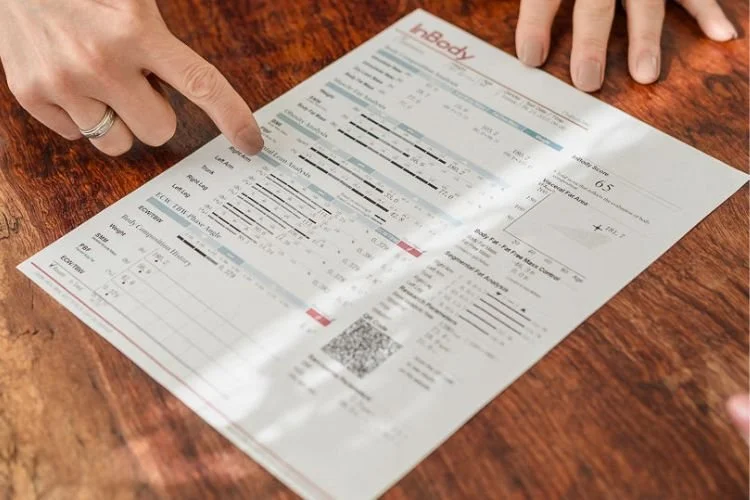
Body composition analysis breaks total weight into its parts: skeletal muscle mass, body fat (separated into subcutaneous and visceral), total body water, and several derived metrics like basal metabolic rate.
For a woman in perimenopause, the most clinically useful numbers are skeletal muscle mass, percent body fat, and visceral fat area. These are the three that tell the real story of what is happening underneath the surface.
A few examples of what tracking these over time can reveal:
A woman whose scale weight has not moved but whose visceral fat is climbing. Her practitioner can see early evidence of metabolic risk before it shows up in standard bloodwork.
A woman who is losing weight quickly on a new program but losing muscle alongside fat. Her practitioner can adjust her protein intake, training, and supplementation before she ends up with a slower metabolism than she started with.
A woman on hormone therapy whose visceral fat has decreased steadily over six months. Her practitioner can see evidence the treatment is supporting her body composition, not just her symptoms.
A single scan is a starting point. Repeated scans (typically every 8 to 12 weeks) show whether what you are doing is working.
What to Do With the Information
Body composition data is most useful when it is paired with action. The tools that have been shown to support healthy body composition during perimenopause are not glamorous, but they work.
Strength training is at the top of the list. Studies on perimenopausal women have shown that resistance training can preserve muscle mass and reduce fat gain over time. Building or maintaining muscle is the single most metabolically protective thing you can do during this window.
Protein intake matters more than it did in your thirties. Most women in perimenopause are under-eating protein. Adequate protein supports muscle preservation and helps with satiety, which becomes harder as ghrelin and other appetite hormones shift.
Sleep and stress are not optional. Cortisol, the stress hormone, drives abdominal fat accumulation directly. Poor sleep amplifies this and disrupts the hunger hormones that regulate appetite. Both can be addressed clinically.
Hormone therapy is a real option for many women. Some research has shown estrogen therapy may have a small direct effect on visceral fat, but in clinical practice, the more meaningful benefit is that hormone therapy can help women feel well enough to do the strength training, protein-prioritized eating, and recovery work that actually change body composition. Hormone therapy does not negatively impact body composition. The decision to use it belongs in a conversation with a qualified menopause practitioner who can review your full health picture.
Beyond these, individual support depends on what your numbers actually show. Two women with the same symptoms can have very different body composition profiles, and the right plan for each will look different.
Why This Matters Beyond the Mirror
Body composition during perimenopause is not just about how clothes fit. The shifts that happen during this transition shape your long-term cardiovascular and metabolic health, often for decades after your final period.
Visceral fat accumulation is associated with elevated risk for cardiovascular disease, type 2 diabetes, and metabolic syndrome. Muscle loss is associated with reduced functional capacity, higher risk of falls in later life, and poorer outcomes across a wide range of health conditions.
Perimenopause is the inflection point where these trajectories are set. The interventions you make in this decade tend to compound for the rest of your life. Tracking body composition is one of the more practical ways to make those interventions visible and adjustable in real time.
Where to Start
If your body has been changing in ways the scale cannot explain, you don’t have to keep guessing. A baseline body composition scan tells you exactly what your weight is made of right now. From there, you have a real reference point to work from.
If you’re in Kelowna and want to see what your body composition actually looks like, book an InBody scan at Ivy Health Clinic. We can help you interpret what the numbers mean for you, and what to do next.
Frequently Asked Questions
-
Ivy Health Clinic offers InBody 580 body composition scans at 202-2900 Pandosy St in Kelowna, BC. Scans are available to anyone, whether or not you are an existing patient. They take about 30 seconds and produce a detailed report on muscle mass, fat mass, visceral fat, and hydration. Booking is available at ivyhealthclinic.janeapp.com or by emailing hello@ivyhealthclinic.com.
-
Most women benefit from rescanning every 8 to 12 weeks. That window is long enough for meaningful change to show up in muscle mass and fat distribution, and short enough to catch early when something is not working. Patients working through specific protocols may scan more often based on their practitioner’s recommendation.
-
Hormone therapy primarily helps with the symptoms of perimenopause: sleep disruption, hot flashes, mood changes, joint pain, and fatigue. Some research has shown a small direct effect of estrogen therapy on visceral fat, but in clinical practice the more meaningful benefit is that hormone therapy can help women feel well enough to train, eat, and recover in the ways that actually change body composition. Hormone therapy does not negatively impact body composition. Whether it is the right choice should be discussed with a qualified menopause practitioner.
-
Body composition tracking is most useful for women noticing changes in their body that are not reflected on the scale, women in active health programs who want to monitor progress beyond weight, and women on GLP-1 medications who want to track muscle preservation. It is not appropriate for people with pacemakers or implanted electrical devices, anyone pregnant, or children under three years old.
This article is for educational purposes only and does not constitute medical advice. The information presented does not create a practitioner-patient relationship. Speak with a qualified healthcare provider for personalized guidance about your perimenopause symptoms, body composition, and treatment options.